
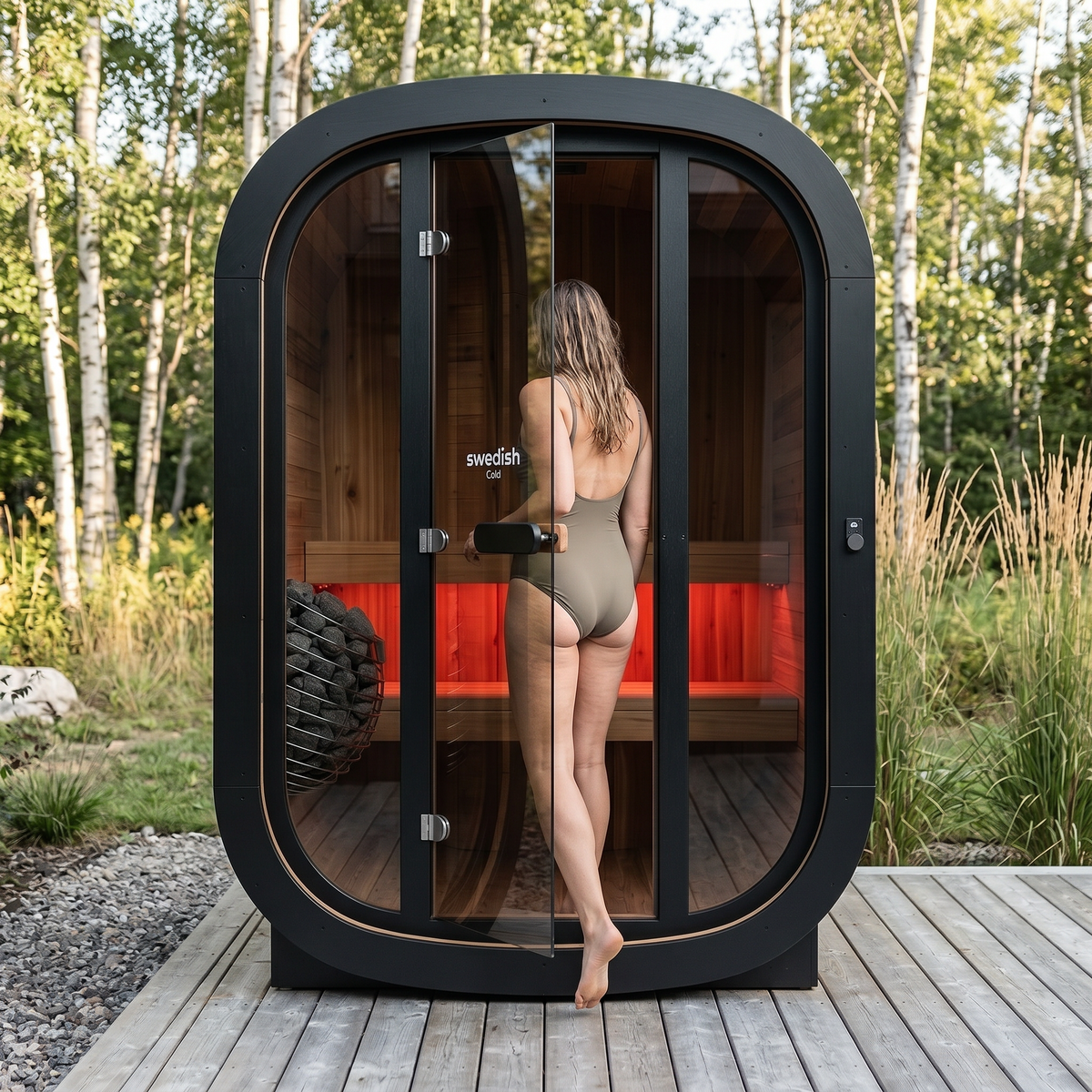
A traditional outdoor sauna can become a natural part of your garden, but a successful project starts with the site. How will the sauna get there? What will it stand on? Is the right electrical supply available? Answering these questions before ordering helps you compare quotations and prepare for delivery.
What is a traditional outdoor sauna?
A traditional sauna uses a heater to warm the room and sauna stones. An infrared sauna uses infrared heating panels instead. Outdoor suitability is a separate feature: the construction must be designed for weather exposure. Putting an indoor sauna under a roof does not make it an outdoor model.
Start with size and seating
Consider how many people will use the sauna at once and how they want to use the benches. A seating capacity does not necessarily mean someone can lie down. Ask for internal dimensions and bench lengths as well as the external footprint.
For a concrete example, Private Escape is described in its current product information as a traditional outdoor sauna for two people, measuring 1,600 × 1,550 × 2,000 mm and weighing approximately 700 kg. Those figures describe the product, not the full space needed for door opening, servicing and safety clearances.
Base, drainage and the route to the sauna
The base must be level and designed for the sauna's weight and use. Discuss ground conditions and structural preparation with the person preparing the site. If using a deck or terrace, have its load capacity checked; looking sturdy is not a structural assessment.
Plan to prevent rainwater collecting around the structure. Consider a safe walking route, lighting and space for towels and cooling down. Follow the model's requirements for ventilation, clearances and access.
Plan the heater and electrical supply together
Select the heater according to the cabin and the manufacturer's sizing requirements. Glazing and insulation can affect the required output. Have a qualified electrician assess the connection, supply and protection before delivery. Do not assume a standard socket is sufficient for a traditional sauna.
Distinguish power from energy: a 6 kW heater running continuously at full output for one hour uses 6 kWh. Actual session consumption depends on warm-up, temperature maintenance and site conditions.
Preassembled or a kit?
Check gate width, passageways, overhead clearance and where the delivery vehicle can stop. A preassembled sauna needs an unloading and positioning plan; a kit requires time, workspace and assembly. Some projects need a crane, but that decision depends on access.
Ask the quote to separate transport, unloading, movement to the final location, assembly, electrical work and commissioning. Check the local requirements and any permissions applicable to your property.
Maintenance and comparable quotes
Plan for cleaning, drying after use and exterior wood care according to the manual. Request material specifications and care instructions for your chosen finish.
Send Swedish Cold photos, a simple dimensioned sketch, your preferred capacity and access details. Explore Private Escape and compare it with Grand Escape. If adding a cold plunge, allow a safe walking route and account for its separate installation requirements.
Share:
Ice bath with a chiller: integrated or external cooling?
Infrared sauna at home: plan space, power and placement